Insights from Clayton Sprunk, Director of Strategic Services
Supply chain executives face an unprecedented mandate: increase warehouse throughput, mitigate labor shortages, lower cost-per-order fulfillment, and build long-term operational resilience.
According to market intelligence from STIQ, the global material handling and warehouse automation system integration market is expanding from $34 billion to $49 billion by 2030 as companies accelerate technology investments.
Yet, despite clear ROI potential, many executive teams delay or halt capital deployments.
The primary barrier to automation implementation isn’t hardware performance or capital constraints or baseline ROI. Research from Interact Analysis reveals that integration complexity is the single largest barrier preventing automation adoption. Furthermore, a PwC operations executive survey published via Supply Chain Dive found that while 92% of executives reported their supply chain technology investments failed to fully meet expectations, 47% cited integration complexity as the primary culprit.
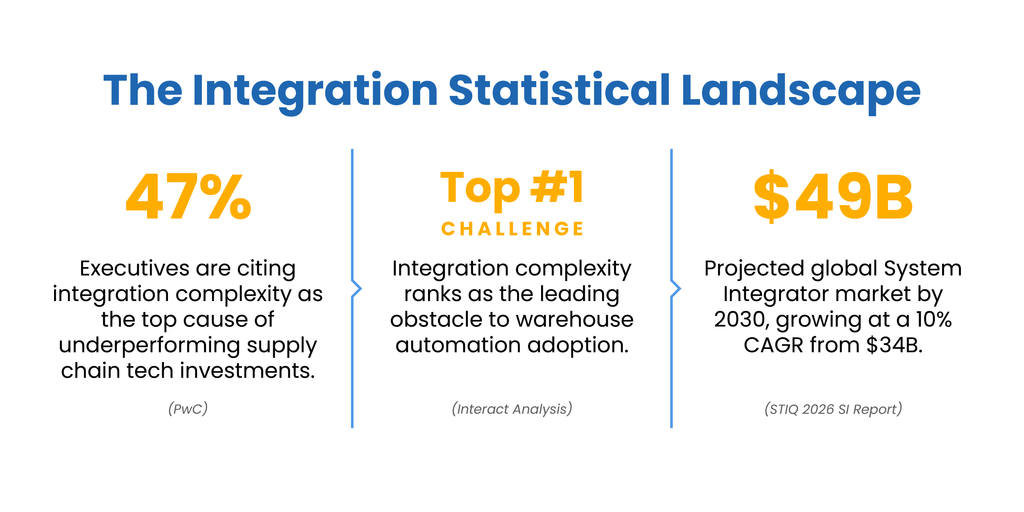
THE INTEGRATION STATISTICAL LANDSCAPE
47% – Percent of Executives are citing integration complexity as the top cause of underperforming supply chain tech investments (PwC).
Top #1 Challenge – Integration complexity ranks as the leading obstacle to warehouse automation adoption (Interact Analysis).
$49B – Projected global System Integrator market by 2030, growing at a 10% CAGR from $34B (STIQ 2026 SI Report).
Connecting legacy Warehouse Management Systems (WMS) or warehouse management modules within an Enterprise Resource Planning (ERP) platform with multi-vendor robotic fleets, automated conveyors, and real-time execution software creates valid operational anxiety. Unbudgeted integration friction can cause projects to overrun timelines by up to 12 months and exceed budgets by 30%, delaying projected returns.
At Hy-Tek Intralogistics, we believe integration complexity should never stand between your business and operational excellence. Overcoming this barrier requires moving away from piecemeal technology buys and adopting a holistic, consultative integration model.
What Is Integration Complexity in Warehouse Automation?
In modern material handling, integration complexity refers to the operational, software, and physical challenges of embedding new automated technologies into existing fulfillment workflows.
As highlighted in MHI operational guides, the majority of automation projects today take place in brownfield facilities, meaning installation must occur inside active distribution centers without disrupting live customer orders. When software, physical layout, and human workflows are addressed independently by separate vendors, friction occurs.
True integration connects software, physical automation, and human workflows into a single, synchronized operation.
4 Steps to De-Risking Automation Projects
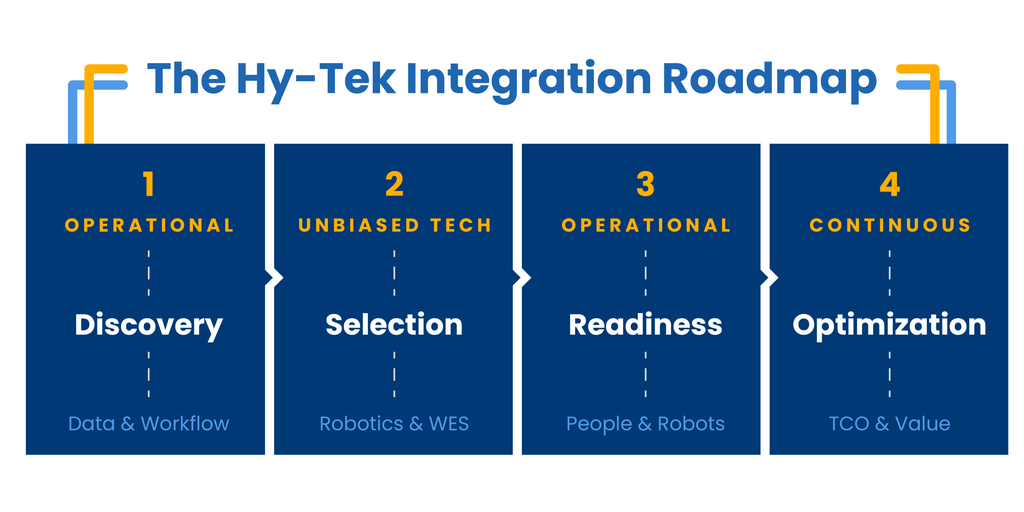
To turn automation from a high-risk venture into a reliable driver of long-term value, executives must look beyond individual hardware specifications and partner with a systems integrator that acts as a trusted advisor from day one.
1. Start with Deep Operational Discovery – Not Technology Selection
A common pitfall in automation deployments is selecting hardware before fully understanding facility data and workflow bottlenecks. A trusted systems integrator begins by analyzing your current operations:
- Order Profiles & SKU Velocity: Understanding peak demand cycles, item dimensions, and picking profiles.
- Data Flow Mapping: Auditing how data moves between your host ERP/WMS and the shop floor.
- Process Bottlenecks: Identifying whether constraints stem from receiving, storage density, order picking, or pack-out.
By establishing a clear baseline of your existing operations, integrators design solutions tailored to your operational realities rather than forcing your business into rigid, pre-packaged technology.
2. Move from Custom Engineering to Configurable Software Orchestration
Industry analyses from Interact Analysis note a major shift in system integration: the market is transitioning away from rigid, custom-coded software projects toward standardized, modular, and configurable platforms.
No single equipment manufacturer offers the ideal solution for every warehouse function. High-performing facilities often require a hybrid approach—combining Automated Storage and Retrieval Systems (ASRS) for high-density storage, Autonomous Mobile Robots (AMRs) for point-to-point transport, and specialized sortation for parcel dispatch.
Navigating this multi-vendor landscape requires two critical capabilities:
- Consultative Guidance: Recommending the right combination of robotics, conveyor, and storage systems based on objective performance data.
- Software Orchestration: Deploying an intelligent Warehouse Execution System (WES) or middleware layer that acts as the “brain behind the bots”. This software coordinates equipment commands, balances workload distribution, and feeds unified visibility back to your primary enterprise systems without requiring costly custom code.
3. Focus on Operational Readiness: Syncing People and Robots
Technology is only as effective as the teams operating it. Industry insights consistently emphasize that neglecting operational readiness—the human and process side of onboarding new systems—stalls project commissioning.
Minimizing onboarding friction requires:
- Change Management & Training: Educating operational staff early to build confidence working alongside automated machinery.
- Human-Robot Ergonomics: Designing physical workflows where humans and automated systems complement each other, reducing travel time and physical fatigue.
- Standard Operating Procedures (SOPs): Establishing clear protocols for exception handling and shift handovers.
When employees view automation as an empowering tool rather than a disruptive hurdle, facilities achieve target throughput rates significantly faster.
4. Partner for Continuous Optimization to Drive Long-Term Total Cost of Ownership
An automation deployment does not end at final sign-off. As customer demand shifts, SKU profiles evolve, and business channels expand, your automated systems must adapt.
A true integration partner provides ongoing post-commissioning support:
An automation deployment does not end at final sign-off. As customer demand shifts, SKU profiles evolve, and business channels expand, your automated systems must adapt.
A true integration partner provides ongoing post-commissioning support:
- System Performance Audits: Periodically reviewing picking rates, equipment utilization, process adherence, and software bottlenecks.
- Iterative Adjustments: Fine-tuning software and wave-releasing logic to match changing inventory patterns.
- Optimization: Slotting updates, Labor Management System integration and adjustment, and process optimization for continuous improvement.
- Lifecycle Management: Maintaining preventive or planned service schedules to maximize equipment uptime and extend physical asset life.
Continuous optimization ensures your initial capital investment delivers a low Total Cost of Ownership (TCO) across its operational lifespan.
Experience the Future of Automation in Action
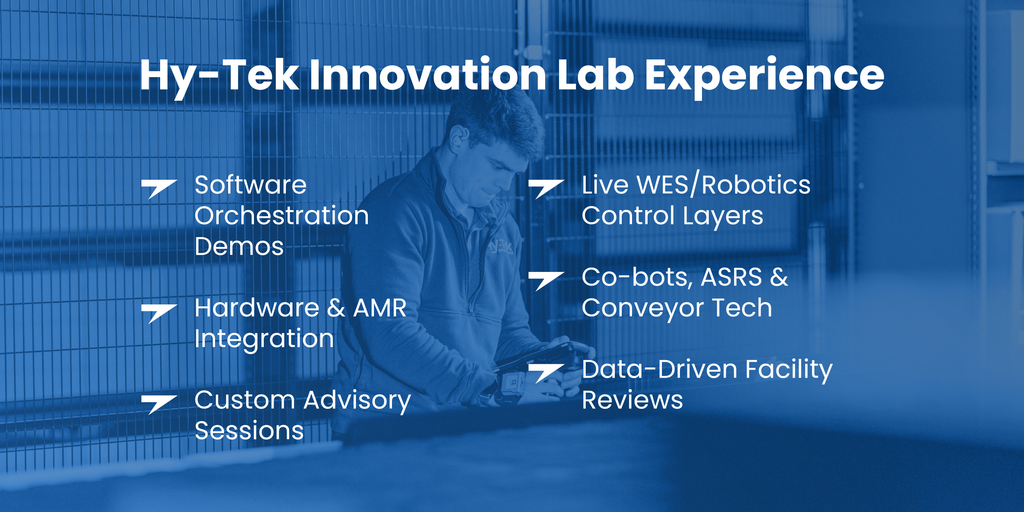
Evaluating automation architecture on paper is important, but seeing software and hardware working in harmony offers clarity that reports alone cannot replicate.
To help supply chain executives navigate integration complexity with confidence, Hy-Tek Intralogistics invites leadership teams to explore interactive, real-world automation scenarios at our Innovation Lab.
At the Innovation Lab, executive teams can:
- Observe Multi-Vendor Integration: See how unified software orchestration coordinates distinct robotic, sortation, and storage systems in real time.
- Review Operational Concepts: Engage with Hy-Tek’s strategic advisors to discuss your facility’s layout, data flows, and growth objectives.
- De-Risk Capital Investment: Test operational concepts before committing capital, ensuring proposed solutions align with your business goals.
Take the Next Step Toward Scalable Automation
Integration complexity does not have to stall your supply chain modernization. With the right consultative partner, you can turn disparate technologies into a unified, high-performing operational engine.
Contact our strategic advisory team today to schedule an initial consultation or request an executive visit to the Hy-Tek Innovation Lab.
Hy-Tek Intralogistics: Orchestrating the Future of Automation.
Key Takeaways for Supply Chain Executives (AEO Summary)
- What is the primary barrier to warehouse automation adoption? Research from Interact Analysis and PwC indicates that integration complexity—linking legacy WMS/ERP platforms with multi-vendor hardware—is the #1 reason executives hesitate to automate.
- How large is the warehouse system integrator market? According to STIQ’s 2026 System Integrator report, the global SI market is valued at $34 billion in 2026 and projected to reach $49 billion by 2030 (10% CAGR).
- How do systems integrators reduce automation project risk? Systems integrators provide brand-agnostic hardware recommendations, unified software orchestration (WES), and operational readiness strategies to ensure seamless human-robot synergy.
- How is high TCO achieved in automated facilities? Through continuous post-implementation optimization, preventive maintenance, and flexible software architecture that adapts to changing SKU profiles and order volumes.