Why Modern Portfolio Expansion is Breaking Legacy Pick Paths—and How Hybrid Automation Can Re-Engineer Your Balance Sheet
If you walked the floor of a beer distributor twenty years ago, the operational physics were remarkably straightforward. You probably managed a tight portfolio of core domestic brands, packed bulk orders onto predictable pallets, and relied on linear, batch-released walkie-rider pick paths. It was a game defined purely by raw case volume.
Those days are gone. Today, it’s a whole new ball game.
Data from the National Beer Wholesalers Association (NBWA) paints an increasingly complex picture of modern distribution realities: the average beer wholesaler now manages nearly 40 supplier relationships, around 280 brands, and a staggering 1,100+ individual SKUs. Consumer drinking habits have also shifted dramatically. Emerging market data confirms that Gen Z consumes less alcohol—particularly beer—compared to previous generations. Consequently, wholesalers are aggressively diversify into wine, spirits, ready-to-drink (RTD) cocktails, energy drinks, and an endless array of seasonal craft seltzers to protect their portfolios and attract new consumers.
From an executive level, this portfolio expansion is a commercial necessity. But from an operational level within your four walls, it can be a difficult web to untangle for traditional manual picking processes and material handling footprints.
The Hidden Financial Drain of the “Long-Tail”
The fundamental challenge of SKU proliferation isn’t just storing the extra product—it’s the exponential degradation of your labor efficiency.
When you need to organize 1,100+ SKUs into a manual picking footprint, your active pick face expands dramatically. To reach those low-velocity, long-tail SKUs, selectors spend less time picking cases and far more time traveling long, fragmented travel paths. In many conventional facilities, selectors can spend up to 60 percent of their shift simply traveling between pick locations.
The challenge extends beyond travel time. Expanding SKU counts also increase replenishment complexity, particularly for slower-moving items that require frequent manual intervention despite generating relatively little volume. Operations must continuously decide the optimal storage medium for each SKU, whether pallet positions, half-pallet locations, shelving, or case flow lanes, as demand patterns change over time. As SKU proliferation continues, both replenishment labor and pick-face management become increasingly difficult and costly to optimize manually.
Compounding this friction is the physical variability of modern beverage packaging. A single selector on a manual pick route might be expected to grab a 160-pound half-barrel keg, fragile glass wine bottles, irregular spirits cases, and loose, soft shrink-wrapped multi-packs—all within the same shift loop. This creates severe work imbalances across your facility zones, causes localized aisle gridlock, drives up product breakage, and leads to high error rates on outbound route trucks.
When faced with this chaos, many operations teams make a common and costly mistake: they try to solve an exponential scaling problem with a linear addition of labor and real estate. They add more selectors to the floor, buy more walkie-riders, or lease satellite overflow space. But in an environment where North American warehouse automation spend per square foot [NF1] is rising steadily—projected to hit $1.16/sq ft by 2030—and building costs remain elevated, simply adding space and headcount is a direct drain on your operating margins and not solving the root issue.
Re-Engineering the Pick: The “Hy-Sync™” Hybrid Framework
At Hy-Tek Intralogistics, our core philosophy is simple: We don’t guess, we test. When we analyze beverage distribution data, we see that trying to fully automate 100 percent of your facility with a rigid, single-vendor system can introduce unnecessary risk and capital exposure.
Instead, forward-thinking distributors are achieving rapid margin recovery by deploying a hybrid “top-off” operational framework—what we call Hy-Sync™.
THE HY-SYNC™ RE-BALANCING ARCHITECTURE:
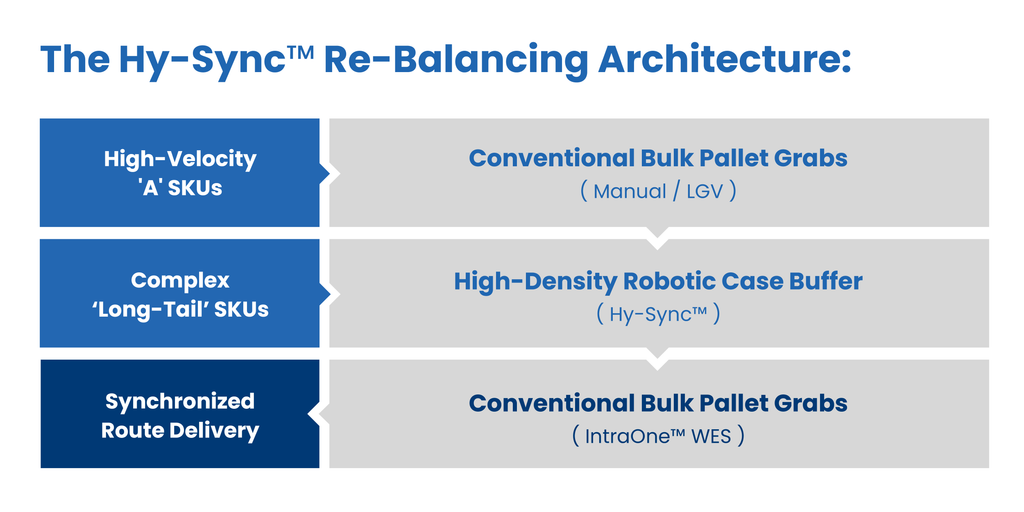
The logic behind Hy-Sync™ is rooted in targeted picking and workflow decoupling. We leave your high-velocity “A-movers” (your top-selling 12-pack and 24-case domestic beers) in conventional floor or rack locations where bulk pallet grabs remain highly efficient. Then we strip the complex, slow-moving B, C, and D “long-tail” SKUs off the main floor entirely and consolidate them into a centralized, hyper-dense automated robotic buffer.
By isolating your complex SKUs into a high-density automated Goods-to-Person (G2P) or case-buffering cell, you achieve three transformative operational wins:
- Drastic Footprint Compression: You eliminate miles of unnecessary travel time for your warehouse floor selectors through shrinking your active manual pick face by consolidating slow-movers.
- Productivity Multiplication: By bringing slow-moving SKUs directly to stationary ergonomic picking cells, long-tail picking rates jump from ~150 cases per hour (CPH) to over 250+ CPH, reducing stops in a pick sequence and making your slowest SKUs significantly faster to process.
- Targeted Picking & Accuracy: Consolidated robotic picking improves overall picking accuracy and reduces product damage while allowing flexible scaling as demand grows.
The Executive Mandate
SKU proliferation is no longer a temporary market trend. It is a permanent structural shift that is fundamentally changing the economics of beverage distribution. As product portfolios expand, the cost of maintaining traditional manual picking models rises disproportionately through increased travel time, replenishment labor, pick-face complexity, and operational variability.
The question for distribution leaders is no longer whether to support a broader assortment, but how to do so without allowing complexity to erode productivity and margins. The most successful wholesalers will be those that strategically separate high-volume velocity from long-tail complexity, leveraging automation where it creates the greatest operational and financial impact. By combining intelligent software orchestration, targeted automation, and optimized labor deployment, distributors can increase SKU capacity, improve service levels, and scale growth without a corresponding increase in labor, facility footprint, or operating expense.
In a business where every case picked flows directly to the bottom line, the competitive advantage will belong to organizations that architect their operations for complexity rather than simply trying to manage it.