Understanding Today’s Benefits and Implementation Options
By Sarah Hollinger, Hy-Tek Vice President, Software Implementation
Automating business-critical operations within your warehouse is no longer optional – it’s become the standard for successful organizations. And often, a Warehouse Execution System (WES) is part of the total automation solution. This can create more questions than answers – what should the full solution look like? Do I also need an automated warehouse control system or management system? What are the types of warehouse execution solutions?
What is a Warehouse Execution System?
It’s the software that orchestrates and optimizes real-time warehouse operations, bridging the gap between planning and execution. In short, by dynamically managing tasks in real-time, such as order prioritization, wave and batch processing, and automated material handling system coordination, the WES ensures optimal connectivity and outcomes between your Warehouse Management System (WMS) and your Warehouse Control System (WCS).
Understanding what a WES is doesn’t answer the more complex challenges our customers often grapple with, like where to start, what processes to analyze, and how to sort through the growing list of robotic options. Solutions in the picking and packing space are becoming more saturated. How can you find the right fit?
Here’s where Hy-Tek and our IntraOne Warehouse Execution team can help. Our experience has shown us that more often than not, customers need a trusted advisor to help guide the process, helping uncover the best opportunities and driving the desired outcomes. Because this is not an implementation many have done before, it can be complex and intimidating. It’s not only a hardware implementation; it’s not only a software implementation. Both must come together to optimize the full system’s potential.
In short, the right solution cansynchronize your labor, automation, and systems in real time—so you can balance throughput, adapt with speed, and scale with confidence. Here, we’re breaking down what a WES is, how it can benefit your warehouse operations, how to know you’re ready, and what a best-in-class implementation looks like.
Understanding Warehouse Execution Systems
In modern warehouses, where automation, robotics, and AI optimization are becoming the standard, WES software fills a crucial need. These systems manage the warehouse’s operational flow while also generating transactional data that allows operational and business leadership to make data-driven decisions on how to optimize. Whether it is to cope with an influx of orders, take on a new order type, mitigate labor onboard, management and cost implications – all these operational & business management decisions can be more agile and more-easily adapted to with the use of a WES.
While a WMS will determine what needs to happen, the WES ensures implementation in the most efficient way, used in the warehouse for balancing order flows, equipment usage and labor resources in real time.
And if used to its best potential, a WES goes beyond managing workflows. It directly influences supply chain resilience, customer satisfaction, and a company’s ability to scale. A strong WES solution ensures that e-commerce surges, seasonal demand spikes, and labor shortages do not cause bottlenecks or missed deadlines.
What Does a WES Do?
Companies often ask, “What does a warehouse execution system do differently than WMS or WCS?” The answer lies in orchestration. A WMS might schedule orders, and a WCS might control conveyors or robots, but the WES ensures all these moving parts are working together seamlessly. They can address a wide variety of tasks and functions, bridging the gaps between traditional WMS, WCS, put/pick-to-light technologies, robotics G2P technologies, and other warehouse operational functions.
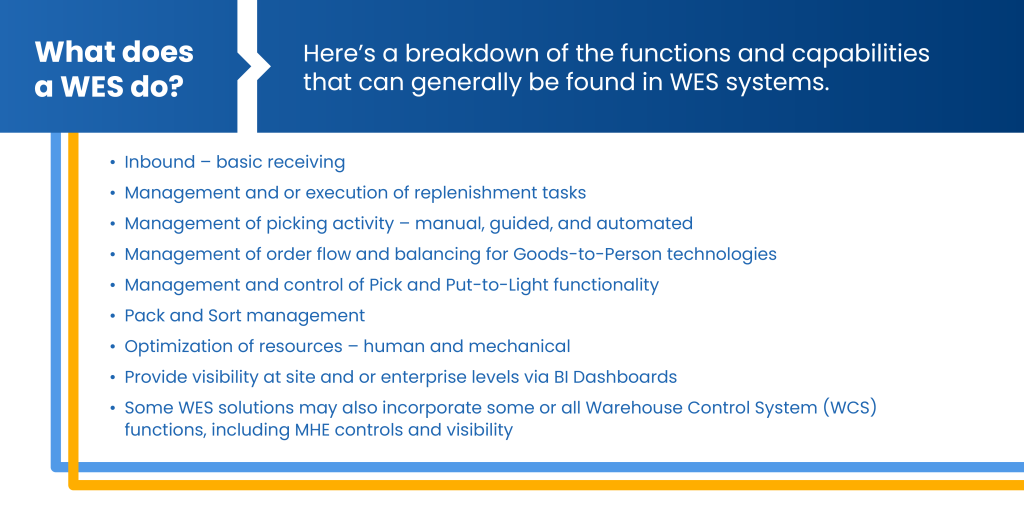
Here’s a breakdown of the functions and capabilities that can generally be found in WES systems.
- Inbound – basic receiving
- Management and or execution of replenishment tasks
- Management of picking activity – manual, guided, and automated
- Management of order flow and balancing for Goods-to-Person technologies
- Management and control of Pick and Put-to-Light functionality
- Pack and Sort management
- Optimization of resources – human and mechanical
- Provide visibility at site and or enterprise levels via BI Dashboards
- Some WES solutions may also incorporate some or all Warehouse Control System (WCS) functions, including MHE controls and visibility
This orchestration can prevent idle time, reduce congestion, and ensure every piece of equipment is fully utilized. Additionally, many modern WES solutions include advanced analytics and machine learning. For example, predictive algorithms can anticipate labor shortages and automatically redistribute work to robotics or other areas of the warehouse. A WES system also enables managers to test different strategies for order prioritization or equipment usage, helping identify which approach delivers the best throughput.
How Does a WES Work?
The WES is often one part of the overall system used to manage the entire warehouse operation, meaning it will likely have strong integration capabilities that enable communication with other systems – both internal and external.
This capability allows data to flow between systems, allowing rapid processing of data across tasks and functions and also allowing operations managers to make real-time adjustments as workflows change, seasonality comes into play, and resource constraints occur, including labor changes.
Lastly, WES systems incorporate advanced algorithms to take the endless feed of data (order data, conveying data, Goods-to-Person system data, etc.) and analyze it to optimize and balance work throughout the warehouse. And this optimization can result in significant improvements throughout the operation.
- In labor utilization, the WES can actively assign work to different zones and users, prioritizing maximum utilization and minimizing downtime.
- For robotics and PTL solutions, WES can group and allocate work from the WMS and WCS, increasing throughput rates.
- Additionally, as the system used to touch operational execution, it becomes the “go-to” point of reference for operational leadership, allowing dynamic user of personal management and the general utilization of all resources.
You may want to know what systems or processes could be impacted by WES?
- Manual order picking (resource balancing)
- Goods to Persons (AS/RS) systems (load balancing)
- Replenishment processes
- Sorter workflow/load balancing
- Pick to Light/Put Walls
- Warehouse management/Dashboards & BI Tools
The Benefits of Implementing a WES
While the justification and ROI from investing in a WES solution will vary for each company based on factors like size, budget, existing technology, and goals, there are benefits that are almost universal if the right WES – and implementation process – are used. Companies adopting WES solutions tend to report significant savings due to decreased labor costs, improved customer satisfaction, faster shipping and higher production even during the highest demand seasons.
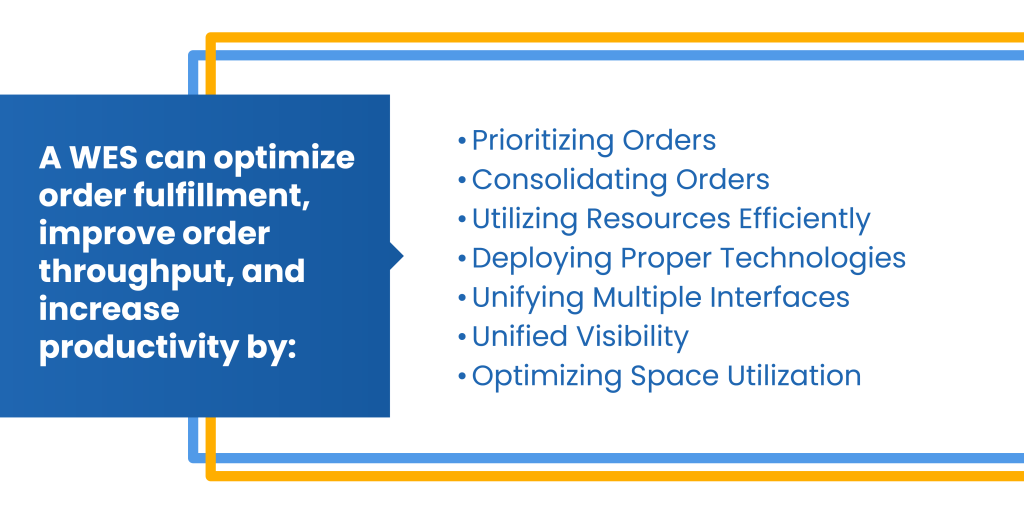
A WES can optimize order fulfillment, improve order throughput, and increase productivity by:
- Prioritizing orders. WES can prioritize orders based on various criteria, such as customer priority, order size, or shipping method. This ensures that high-priority orders are processed quickly and efficiently.
- Consolidating orders. WES can consolidate multiple orders into a across technology requirements, ensuring proper technology usage for optimal, consolidated processing.
- Utilizing resources efficiently. With prioritized orders, a WES can allocate all resources, including human and mechanical, to maximize throughput and return on technology investments.
- Deploying proper technologies . Companies can deploy a wide variety of technologies under a unified approach, ensuring best-fit solutions for operational requirements.
- Unifying multiple interfaces. With Hy-Tek’s IntraOne Software, user experience is standardized across different technologies and subsystems.
- Unified visibility. WES provides companies with enhanced visibility across multiple activities and resources for the site.
- Optimizing space utilization. Maximizes use of space while eliminating bottlenecks and mistakes.
Am I Ready for a WES?
The answer to this question depends on many things, including the size of your organization and facility, the current level of automation, the operational and IT infrastructure needed to support complex automation, and much more.
Warehouses and DCs are processing more orders than ever, and the pressure on companies to handle traditional distribution models as well as aggressive e-commerce requirements is only increasing. With labor becoming scarcer, companies are turning to technology in order to maintain their competitive advantages like niche handling requirements for unique product types and order types and the optimal combination of modular hardware and software solutions. And this makes consideration of WES a needed piece of the conversation.
WES can be customized to fit any company’s needs and budget, meaning the time is always right for this type of solution. It’s a smart investment for companies that want to streamline their operations and ensure long-term success.
If you’re dealing with unpredictable order volumes or a combination of B2B and B2C customers, the newfound ability to balance workloads, switch between manual and automated processes and maintain visibility across the supply chain can be very impactful.
The key is assessing whether your current systems are lacking efficiency. If orders are consistently delayed or employees are overwhelmed, it may be time to test a WES system. And we can help.
What’s Next?
WES solutions can empower more agile change, allowing you to adapt and grow with technology. It’s often the gateway to many of these technologies, serving as the bridge between all of them. As AI, IoT and robotics progress, the use of WES software will become even more critical. Companies investing in WES now are positioning themselves for immediate efficiency gains as well as long-term versatility.
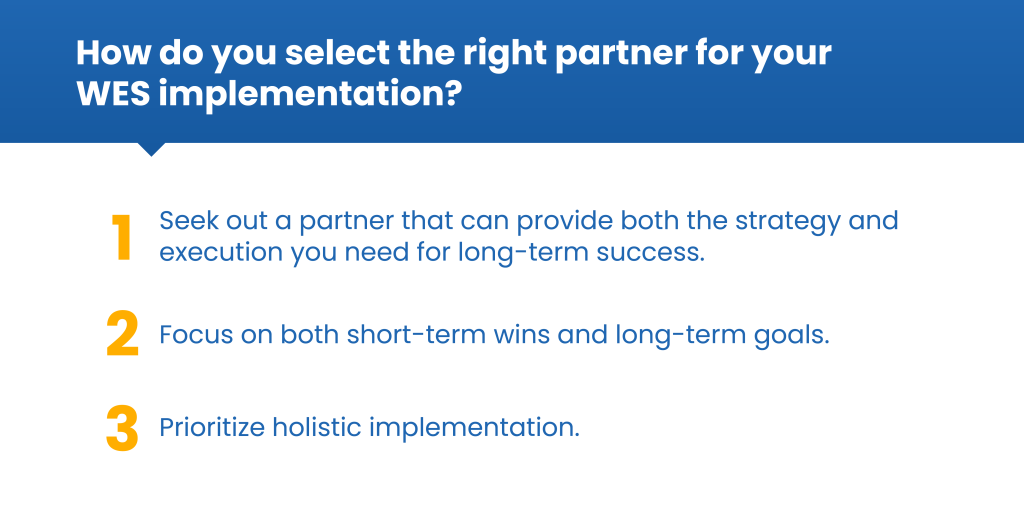
So how do you select the right partner for your WES implementation?
1. Seek out a partner that can provide both the strategy and execution you need for long-term success. This means finding a partner that can help architect the roadmap, de‑risk delivery, and stand up the right support model post‑go‑live. A trusted partner’s approach should acknowledge these realities and directly address them with clear strategy, a staged roadmap, and measurable outcomes.
2. Focus on both short-term wins and long-term goals. When evaluating partners, you have to think beyond the first robot or the first use case. Can the recommended platform integrate multiple robotic solutions? Can it orchestrate work assignments across different systems? Are coordinations smooth between robots, controls and humans?
The goal is to find a platform that is hardware‑agnostic and API-first, which allows for growth without being locked in and limiting future integrations. The best WES vendors are standardized, scalable, and vendor‑agnostic. The goal is flexibility—not being locked into a single hardware vendor’s ecosystem.
3. Prioritize holistic implementation. What does this mean? It means that best-in-class partners bring a strategy to implementation that includes WES (and WMS and WCS) design, testing, training, cut-over, go-live, hyper-care, support and maintenance, and KPIs and value tracking. And this is easier said than done. At Hy-Tek, we offer customers our Innovation Lab, where you can see some of our strategic partners in action, including one of the first functioning Exotec NexGens in the world. You can also leverage our strategic services team to identify the readiness of your staff and your operations in advance of your implementation. They can also help you get the right analysis of your orders, products, and physical layouts with restrictions to help you select the best robotic components for your operations and business.
Future warehouse execution systems may use analysis to predict demand in advance, automatically update schedules and even integrate with suppliers for improved supply chain organization. This expansion will make WES more than just a simple tool for warehouses; it will become a strategic move to enhance overall business competitiveness for the years to come. Make sure you’re working with a leader in WES strategies and solutions.
To help you get started, download our “How to Get Started” Questionnaire today.
You Have Questions? We Have Answers. Explore our FAQs.
What are the different types of warehouse systems?
The main types of warehouse systems are warehouse management systems (WMS), warehouse execution systems (WES), and warehouse control systems (WCS).
What does a warehouse execution system do?
A warehouse execution system (WES) is software that orchestrates and optimizes real-time warehouse operations, bridging the gap between planning and execution. The WES ensures optimal connectivity and outcomes between your Warehouse Management System (WMS) and your Warehouse Control System (WCS).
What is the difference between WMS and WES?
A Warehouse Management System (WMS) is the system of record for the warehouse. It owns inventory, manages orders, enforces compliance, and makes high-level decisions about what work needs to happen — which orders to fulfill, what’s in stock, and where things are stored.
A Warehouse Execution System (WES) sits below that and handles how that plan actually gets carried out. It takes the large-scale plan from the WMS and translates it into moment-by-moment task assignments across labor, robotics, and automation equipment on the floor.
What are the differences between WES and WCS?
A Warehouse Control System (WCS) is essentially the translator between software and machinery — it takes instructions and converts them into the signals that make physical equipment like conveyors and sorter, directing them physically.
A Warehouse Execution System operates at a higher level, focusing on the bigger picture: making sure the right work is flowing to the right place, or WCS-controlled sub-system, at the right time, keeping the whole operation balanced and moving efficiently.
What is an example of a WES?
Hy-Tek’s WES module of IntraOne Software enables you to build upon your existing warehouse control systems to develop a complete, scalable system of WCS and WMS technologies. Our easily expandable platform integrates seamlessly with a complete library of automated solutions, including robotics, sortation, print-and-apply systems, and industrial control systems.
Want to learn more?
Talk with one of our IntraOne Warehouse Execution experts today.