By: Clayton Sprunck, Director, Strategic Services at Hy-Tek Intralogistics
Source Article: 2026 Warehouse Automation Trends: Where Software, AI, and Robotics Converge
The Upstream Shift: Why Inbound Deserves the Spotlight
For decades, the standard playbook for distribution center automation prioritized outbound fulfillment. The logic seemed simple: speed up picking, packing, and dispatch to meet tightening customer SLAs. However, focusing exclusively on outbound performance creates an expensive illusion of efficiency if the inbound dock remains a manual bottleneck.
Inbound receiving and returns processing remain some of the highest cost centers within a distribution center. They are inherently labor-intensive, driven by vendor compliance variances, mixed-SKU pallets, and intensive manual unloading.
As highlighted in the 2026 Warehouse Automation Trends Report, attention is officially turning to the receiving dock. From robotic depalletizing and AI-enabled neural vision inspection to low-code robotic interfaces and dynamic Automated Storage and Retrieval Systems (AS/RS), the technology required to automate inbound processes has matured rapidly.
While these technological advancements present transformative opportunities, deploying them successfully requires moving past industry buzzwords and focusing on sound engineering fundamentals.
Facility Design & Sizing: Designing for Peaks, Not Averages
When evaluating automated depalletizing, automatic case handling, or dock robotics, facility design teams must alter how they simulate dock layout and staging parameters.
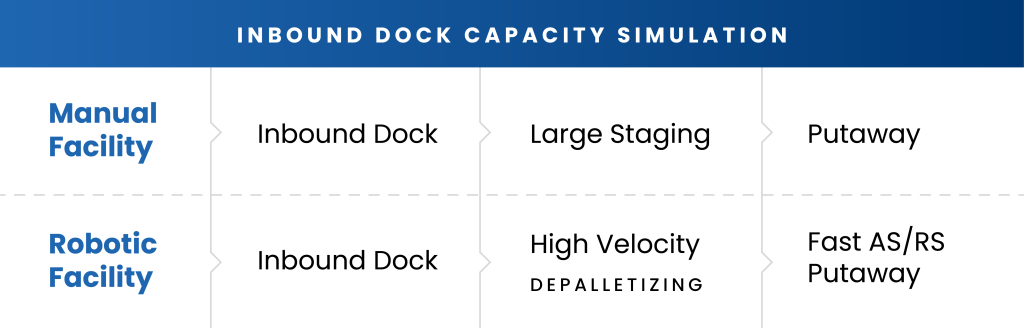
In a traditional manual facility, significant floor space is allocated to staging both in-process pallets and completed pallets waiting for putaway. High-throughput robotic palletization and depalletization dramatically reduce the need for inbound pallet staging on the dock floor. Because processing velocity increases, less staging space is required for in-process goods, though system design must accommodate higher putaway throughput to keep the dock clear.
When evaluating receiving logs to determine whether an inbound retrofit is financially viable, executives must focus on peak demand rather than average daily throughput. Designing an automated receiving system around average volumes results in an undersized system incapable of handling seasonal or promotional spikes. Conversely, overbuilding hardware strictly for a single peak day creates unnecessary capital expenditure.
The ideal approach pairs right-sized automation with operational levers—such as overtime or extra shifts—to absorb peak volume while maximizing ROI against baseline manual labor costs.
Modeling Flow & Utilizing the Vertical Cube
To prevent conveyor gridlock and staging cell bottlenecks during inbound container de-stuffing spikes, engineering teams should leverage advanced process modeling and discrete-event simulation. By modeling dwell times and volume surges beforehand, operations teams can smooth handoffs between interrelated processes, ensuring downstream equipment matches upstream demand.
Furthermore, integrating dynamic AS/RS into the inbound workflow fundamentally transforms facility economics. Historically, warehouse capacity has been measured strictly in square footage. High-density AS/RS utilizes the full vertical cube of a building, significantly lowering the cost per cubic foot and eliminating the need for expensive real estate expansion.
The Brains of the Operation: WES & Data Integrity
The foundation of any modern fulfillment center is its software execution layer. A robust Warehouse Execution System (WES)—such as Hy-Tek’s IntraOne platform—acts as the “brain behind the bots”, orchestrating software, robotics, and human teams into a unified workflow. Beyond orchestration, a WES provides real-time operational visibility, allowing managers to monitor exception handling and dynamically reallocate labor.
However, even the most sophisticated WES or AI-driven vision system relies entirely on data maturity. AI models and vision platforms are only as effective as the data quality fed into them. Building clean data structures around Units of Measure (UOM), case dimensions, and units-per-pallet is an essential prerequisite. Deploying AI tools without strict data guardrails can quickly introduce operational errors.
Strategic Takeaways for Supply Chain Executives
Automation and artificial intelligence are making leaps and bounds every year. Technologies that felt emerging or risky a year ago are now proven, accessible solutions. Yet, success lies in balancing innovation with practicality:
- Avoid Buzzword Trap: Don’t adopt technology simply because it is trending;
- Eliminate Unnecessary Touches Upfront: Leverage ASN/EDI data flows and vendor compliance audits to drive direct-to-storage paths and handle exceptions by exception.
- Select an Experienced Partner: Partner with an integrative consultant who understands how to evaluate historical SKU data, model process flows, and design flexible systems built for long-term TCO.
Looking to evaluate your facility’s inbound operations or model an upcoming automation retrofit? Connect with Hy-Tek’s Strategic Advisory Team to learn how we can help you navigate integration complexity and Orchestrate the Future of Automation.